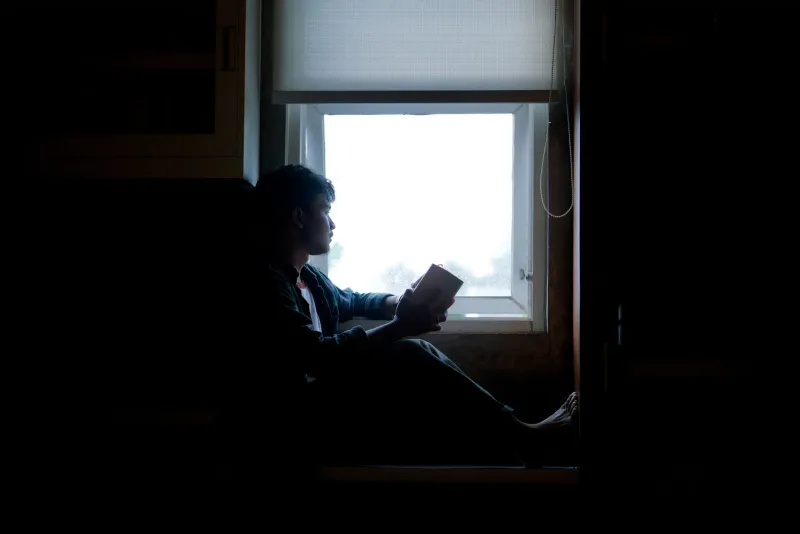
When a Book Cracks You Wide Open: The Novels That Force You to Face Yourself

You know the feeling. You're reading quietly — maybe on the couch, maybe in bed with the lamp on low — and then a single sentence hits you somewhere between the ribs. Not because it's beautiful, exactly. Because it's true. True in a way that feels uncomfortably personal, like the author somehow got access to a corner of your inner life you haven't shown anyone.
That's not an accident. It's craft. And it's one of the most quietly powerful things fiction can do.
At Ran Carr Books, we talk a lot about stories that spark conversation — but some of the most important conversations a book can start aren't with other people. They're with yourself. The kind that happen at two in the morning when you've set the book down and you're staring at the ceiling, wondering why a fictional character's worst moment felt so uncomfortably familiar.
Why We Go to Fiction for the Stuff We Can't Say Out Loud
There's a reason people describe certain books as "life-changing" while struggling to explain exactly how. It's not always about plot. It's not always about a character who shares your background or your zip code. Sometimes it's about emotional precision — a writer who maps the interior landscape of shame, grief, or longing with enough accuracy that you feel genuinely seen by a story that has nothing to do with your actual life.
Psychologists have a term for this: bibliotherapy. The idea that narrative can function as a form of emotional processing. But you don't need clinical language to understand it. You've lived it every time a novel made you cry in public on the subway or forced you to put a book down for a week because you just weren't ready.
The books that break us open tend to share a few qualities. They don't flinch. They don't resolve the uncomfortable stuff too quickly. And they trust the reader to sit with something difficult without being handed an easy answer.
The Shame Conversation Nobody Wants to Have
Of all the emotional territories that fiction navigates, shame might be the most transformative — and the most avoided. We're pretty good at talking about grief in books, even anger. But shame? That quieter, stickier feeling that says something is fundamentally wrong with you? That one tends to live in the subtext.
The novels that handle it well don't announce themselves. They sneak up on you through a character who makes a choice you'd never make — or a choice you absolutely would make and have never admitted to anyone. The reader's relationship with a flawed character becomes a kind of safe container for feelings that would be too exposed in real life.
This is part of what makes contemporary fiction so valuable right now. In a cultural moment when authenticity is both celebrated and immediately commodified, good literary fiction creates a space that's genuinely private. Just you, the page, and whatever you're willing to admit to yourself.
Vulnerability as a Literary Device (and a Personal Reckoning)
The best writers understand that vulnerability on the page has to be specific to land. Generic sadness doesn't move people. A character who is sad in a recognizable, particular, slightly embarrassing way? That moves people.
Think about the novels that have stayed with you longest. Chances are, they didn't just make you feel something — they made you feel something about yourself. A realization about how you handle conflict. A recognition of a pattern in your relationships. A moment where you thought, oh, I do that too, and I've never wanted to look at it directly.
That's the mirror function of fiction at its most potent. Not reflection for the sake of vanity, but reflection that creates genuine self-awareness. The kind that's a little uncomfortable and completely necessary.
Why These Books Linger
Here's something worth thinking about: the novels that haunt us tend to be the ones that didn't fully resolve. Not because they were poorly constructed, but because they were honest about the fact that some things don't resolve. Relationships that end ambiguously. Characters who grow but don't transform into better versions of themselves overnight. Endings that feel like a pause rather than a conclusion.
Life doesn't wrap up cleanly, and neither do the stories that feel most true to it. When a book lingers in your psyche for months — when you find yourself thinking about a character while you're doing something completely unrelated — it's often because the story touched something that's still unfinished in you.
That's not a flaw in the reading experience. That's the whole point.
What to Do With the Feeling
If you've ever closed a book and felt genuinely shaken, you don't need to analyze your way out of it. The instinct to immediately find a framework — to explain why this story affected you — can actually short-circuit the very thing the book was trying to do.
Sometimes the most honest response is just to let it sit. To notice what it brought up. To maybe have a conversation with someone you trust about the thing the book made you think about — not the book itself, but the real-life thing hiding behind your reaction to it.
That's the conversation Ran Carr Books is always trying to start. Not just "what did you think of this novel" but "what did this novel make you think about yourself." Those are very different questions, and the second one is almost always more interesting.
The books that break us open aren't trying to hurt us. They're trying to get us somewhere we've been reluctant to go. And more often than not, it's exactly where we needed to be.