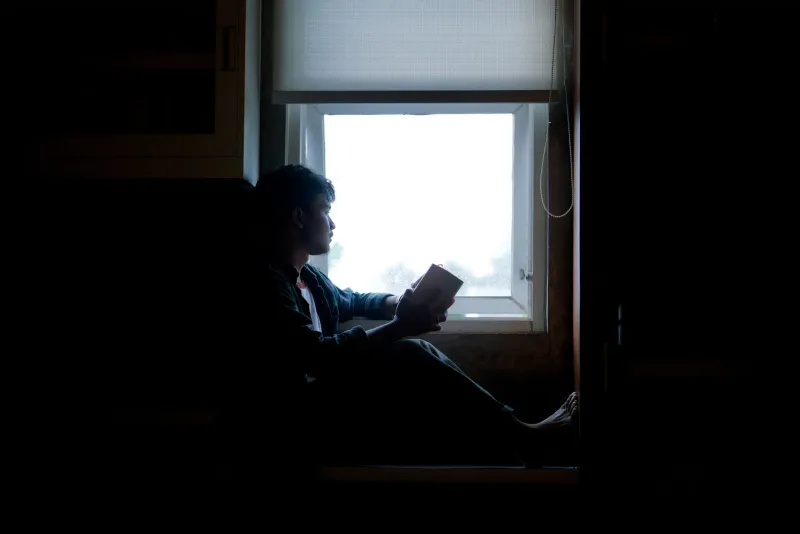
You Read It at Exactly the Wrong Moment — and It Wrecked You in the Best Way

There's a version of reading that's comfortable and controlled. You finish one book, browse your to-be-read list, pick something that sounds appealing, and settle in. Orderly. Intentional. Fine.
And then there's the other kind.
The kind where you grab something off a friend's shelf at random, or download a novel on a whim at midnight, or finally get around to that paperback that's been sitting on your nightstand for two years — and you happen to open it three days after your marriage falls apart, or the morning after you quit a job you've had for a decade, or on a flight home from a funeral.
That's not comfortable reading. That's something else entirely.
When the Story Meets the Season
Most of us have at least one book that belongs to a specific chapter of our lives — not because we planned it that way, but because the timing made it unavoidable. The story landed in the middle of something real, and the two things fused together in a way that's almost impossible to separate afterward.
Readers talk about this all the time, though they don't always have language for it. A woman in her late thirties describes picking up a novel about a character rebuilding her identity after divorce — not because she was going through one, but because she was bored on a Saturday. By chapter three, she was crying in ways she hadn't in months. "I wasn't even in crisis," she says. "I just didn't know I needed to be seen until the book did it."
A college student mentions reading a novel about estrangement from a parent during the exact week he stopped returning his father's calls. He didn't finish it for six months. When he finally did, he called his dad the same afternoon.
These aren't coincidences, exactly. But they're not entirely predictable either. They exist in that strange overlap between where you are and what a book happens to say.
The Psychology of Reading in Context
Here's what's actually happening when a book hits differently because of timing: your emotional state acts as a filter — and sometimes as an amplifier. Psychologists who study narrative transportation, the process by which readers become absorbed into a story's world, have found that our capacity for that kind of immersion is directly tied to what's happening in our real lives.
When we're in the middle of something difficult, our defenses are lower. We're not reading as critics or casual consumers. We're reading as people who need something, even if we don't know what. That need makes us porous in a way that changes how deeply a story can reach.
The author of a novel about grief, for instance, isn't writing for someone who just lost a parent. They're writing from their own experience, for a general audience, hoping to tell a true story. But when that book lands in the hands of someone three weeks out from a loss, it becomes something the author never specifically intended — a private conversation, a life raft, a mirror held up at exactly the right angle.
The book didn't change. The reader did.
The 'Wrong Time' That Turns Out to Be Right
What makes this phenomenon particularly interesting is the way readers describe these moments in retrospect. Almost universally, they use the language of wrongness — wrong time, wrong headspace, not ready for it — paired immediately with the acknowledgment that it was, in some undeniable way, exactly right.
There's a reason for that tension. Books read during crisis or transition don't offer the detached appreciation we get from reading in calmer moments. They don't let us admire the prose from a safe distance. They get in. They ask things of us. They make us feel implicated in ways that are uncomfortable and clarifying at the same time.
A reader who encountered a novel about ambition and self-betrayal during a period of professional burnout puts it this way: "I kept wanting to put it down. The main character was doing exactly what I'd been doing for five years, and watching her do it in slow motion was almost unbearable. I finished it in two days."
That's the paradox. The books that arrive at the worst possible moment are often the ones we can't stop reading — and can't stop thinking about long after.
Why We Remember These Books Differently
Ask someone to name a book that genuinely changed them, and nine times out of ten, they'll also tell you when they read it. The two things are inseparable. The story and the season become one memory.
This is different from simply enjoying a book. Plenty of novels are enjoyable and then fade. The books that stick — the ones that get referenced years later, recommended with an almost urgent insistence, returned to in moments of confusion or grief — tend to be the ones that arrived when something in us was already cracked open.
That's not a flaw in the reading experience. It's actually a testament to what fiction can do that almost nothing else can. A book doesn't know what you're going through. It doesn't adjust its language to spare your feelings or soften the parts that might sting. It just says what it says, and sometimes what it says lands directly on the thing you most needed someone to name.
The Invitation to Pay Attention
If there's a takeaway here — and this isn't really that kind of piece, but stay with it — it might be this: pay attention to the books that find you at inconvenient times.
The one you almost didn't read. The one you started and abandoned twice before finally finishing it during a week you'd rather forget. The one a stranger pressed into your hands at a party and you only cracked open because you couldn't sleep.
Those books aren't accidents. Or maybe they are, technically. But the way they land — the way they press on exactly the bruise you didn't know you had — that part isn't random. That's you, meeting a story at the precise moment you had the capacity to actually hear it.
And sometimes the worst timing is the only timing that would have worked.